
- By Nashtech PEB Team
- Jun 11, 2026
- 0 Views
What is a Canopy in PEB Structures? Types, Benefits & Industrial Applications Explained
High-tech industrial buildings also have to be convenient to operate, as well as structurally sound. In today's context, commercial steel structures, logistics centers, factories and warehouses need extra functional areas providing better loading facilities, weather protection and movement efficiency. Canopies in PEB structures are where they can be of great significance. At first thought, a canopy might be viewed as an insignificant addition to any industrial building, however the effect on practicality and usability is significant.
PEB canopies have been gaining popularity in recent years for a number of industrial and commercial construction projects in India. In today's business environment, structures that protect loading areas and entrances while safeguarding vehicles and exterior workspaces with minimal impact to the main building are a desirable option. A PEB canopy is a structure that can be used in a variety of industrial settings, such as a warehouse loading bay, factory entrance or commercial parking space, and can provide long-lasting, cost-effective and attractive results.
Table of Contents
- What is a Canopy in a PEB Structure?
- Why Canopies are Important in PEB Buildings
- How PEB Canopies Differ from Traditional Canopies
- Main Components of a PEB Canopy
- Types of Canopies in PEB Structures
- Benefits of Canopies in PEB Structures
- Applications of PEB Canopies
- Why Steel Canopies are Preferred in Modern Construction
- Importance of Proper Canopy Design
- Future of PEB Canopies in India
- Conclusion
- FAQs
What is a Canopy in a PEB Structure?
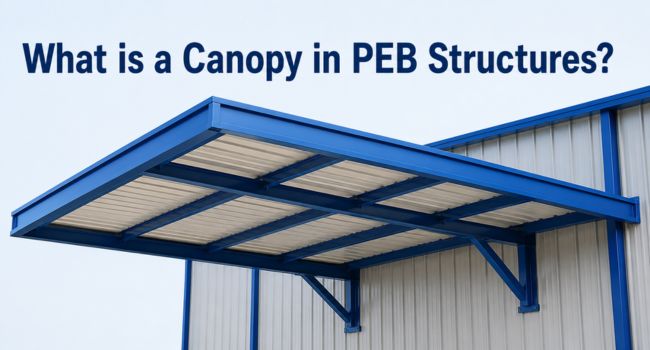
A canopy in a PEB structure is an extended roof-like projection attached to the main building.
It is usually installed outside the structure to provide additional covered space for:
- Loading and unloading activities
- Vehicle protection
- Entrance coverage
- Outdoor work areas
- Walkways and parking sections
In modern Pre Engineered Buildings (PEB), canopies are designed using steel framing systems integrated with the main building structure.
Why Canopies are Important in PEB Buildings
Industrial and commercial buildings often require covered external areas for operational convenience.
Without proper protection, rain, heat, and weather exposure can affect:
- Material handling operations
- Vehicle movement
- Loading activities
- Employee movement
- Equipment storage
This is why PEB steel canopies are widely used in warehouses, factories, and logistics facilities.
How PEB Canopies Differ from Traditional Canopies
Traditional canopies are usually constructed using concrete or conventional steel fabrication methods.
Modern PEB canopy systems are different because they are:
- Pre-engineered
- Lightweight
- Faster to install
- Structurally optimized
- Easier to expand
Since they are integrated into the overall building design, they also provide better structural consistency.
Main Components of a PEB Canopy
A typical PEB canopy structure generally includes:
- Steel support columns
- Roof framing systems
- Purlins and bracing
- Roofing sheets or insulated panels
- Fasteners and connection systems
Depending on operational requirements, the canopy size and design can be customized.
Read More: PEB Structure Components Explained
Types of Canopies in PEB Structures
Entrance Canopy
Entrance canopies are installed near the main entry of industrial or commercial buildings.
They provide protection from:
- Sunlight
- Rainfall
- Weather exposure
These canopies also improve the overall appearance of the building.
Loading Bay Canopy
Loading bay canopies are commonly used in warehouses and logistics hubs.
They help protect:
- Goods during loading and unloading
- Trucks and transport vehicles
- Material handling equipment
This improves operational efficiency during all weather conditions.
Parking Canopy
Parking canopies are used to provide covered vehicle parking areas.
These are commonly installed in:
- Industrial plants
- Commercial buildings
- Warehouses
- Office facilities
Modern steel parking canopies are highly durable and require less maintenance.
Walkway Canopy
Walkway canopies provide covered pedestrian movement areas between different sections of a building.
They improve comfort and safety during rain or excessive heat.
Cantilever Canopy
Cantilever canopies are designed without front support columns.
These canopies create cleaner open spaces and are commonly used in:
- Commercial buildings
- Showrooms
- Loading areas
They provide a modern architectural appearance while maintaining functionality.
Mezzanine Extension Canopy
Some industrial buildings use canopy extensions along mezzanine sections for additional covered operational space.
These are useful for:
- Material storage
- Packing areas
- Outdoor operational workspaces
Benefits of Canopies in PEB Structures
Better Weather Protection
One of the biggest advantages of PEB canopy systems is protection against environmental conditions.
Canopies help protect:
- Workers
- Goods
- Vehicles
- Equipment
from rain, sunlight, and moisture exposure.
Improved Operational Efficiency
Warehouses and factories often continue operations throughout the year.
Covered loading and movement areas help improve:
- Material handling speed
- Worker convenience
- Loading efficiency
- Outdoor workflow continuity
This becomes especially important during monsoon seasons.
Also Read: Monsoon-Ready PEB Structures
Additional Functional Space
Canopies provide extra usable covered space without increasing the main enclosed building area.
This allows businesses to create:
- Temporary storage sections
- Waiting areas
- Outdoor operational zones
- Vehicle protection areas
without major structural expansion.
Faster Installation
Modern PEB steel canopies are fabricated before installation, reducing project timelines significantly.
Compared to traditional construction methods, installation becomes much faster and more organized.
Low Maintenance
Properly coated steel canopy systems are designed for long-term durability.
Modern PEB canopy structures require less maintenance because they are:
- Corrosion-resistant
- Structurally optimized
- Weather-protected
This reduces repair and upkeep expenses.
Better Visual Appearance
Canopies also improve the architectural appearance of industrial and commercial buildings.
Modern canopy designs create a cleaner and more professional exterior look.
Flexible Design Options
PEB canopies can be customized according to:
- Building dimensions
- Operational requirements
- Vehicle movement needs
- Architectural preferences
This flexibility makes them suitable for multiple industries.
Applications of PEB Canopies
Warehouses and Logistics Hubs
Loading bay canopies improve inventory movement and weather protection.
Industrial Factories
Factories use canopies for material handling areas and outdoor operational spaces.
Commercial Buildings
Commercial projects often install entrance and parking canopies for customer convenience.
Automobile Showrooms
Canopies are commonly used for vehicle display and covered parking spaces.
Agricultural Storage Facilities
Agricultural projects use canopy extensions for machinery and crop protection.
Why Steel Canopies are Preferred in Modern Construction
Steel canopies provide several advantages compared to traditional concrete structures.
Modern PEB steel canopy systems offer:
- Faster construction
- Better structural flexibility
- Lightweight design
- Easier future modifications
- Lower maintenance
This makes them highly practical for industrial infrastructure.
Importance of Proper Canopy Design
A poorly designed canopy can create structural and operational issues.
Proper PEB canopy design ensures:
- Load stability
- Proper drainage
- Wind resistance
- Structural durability
- Safe operational movement
This is why professional engineering and fabrication are important.
Future of PEB Canopies in India
As industrial and commercial construction continues growing in India, the demand for functional and flexible external structures is also increasing.
Modern businesses now prefer:
- Faster infrastructure solutions
- Weather-protected operational areas
- Low-maintenance structures
- Scalable building systems
In this context, it is likely that PEB canopy structures will see increased use in industrial/commercial projects in India.
Conclusion
Although canopies might appear to be a minor component of a facility, they can have a significant impact on the functionality, operations and weather protection of contemporary industrial infrastructure.
This is the main reason that many establishments are opting for the use of PEB canopies for their warehouses, factories, logistics centers, commercial buildings, and industrial facilities. They are one of the most functional additions to modern PEB buildings due to the ease of installation, versatility, low maintenance and steel construction.
With the ongoing evolution of industrial construction, steel canopy systems in PEB buildings will continue to play a vital role in modern, efficient and future-proof PEB infrastructure.
FAQs
1. What is a canopy in a PEB structure?
A canopy is an extended roof structure attached to a building for weather protection and additional covered space.
2. What are the common types of PEB canopies?
There are different types of canopies like entrance canopies, loading bay canopies, parking canopies, walkway canopies, and cantilever canopies are commonly used.
3. Why are canopies important in warehouses and factories?
They improve loading efficiency, protect goods and workers, and provide covered operational space.
4. Are PEB steel canopies durable?
Yes, properly designed steel canopies are weather-resistant, strong, and require low maintenance.
Recent Post
Copyright ©2025 All Rights Reserved by nashtechpeb.com